El Palacio da Pena es una fusión de múltiples estilos arquitectónicos, incluidos elementos góticos, moriscos, manuelinos y renacentistas. Esta mezcla deliberada pretendía evocar un pasado onírico y fantástico, típico de la sensibilidad romántica.
En lo alto de Sintra, Palacio da Pena parece sacado de un libro de cuentos. Esta obra maestra del siglo XIX, actualmente sitio del Patrimonio Mundial de la UNESCO, es uno de los ejemplos más impresionantes del Romanticismo que jamás hayas visto. A medida que explores, notarás dos secciones distintas: el tranquilo y desgastado monasterio y el vibrante y teatral palacio construido a su alrededor. Cada arco, azulejo y torrecilla tiene una historia que contar, y desde aquí arriba, las vistas se extienden hasta Lisboa en un día despejado.
El Palacio da Pena es uno de los mejores ejemplos de arquitectura romántica del siglo XIX del mundo. Su diseño es una mezcla deliberada de estilos, referencias históricas e imaginación artística, que refleja tanto el gusto personal del rey Fernando II como el espíritu de la época romántica.
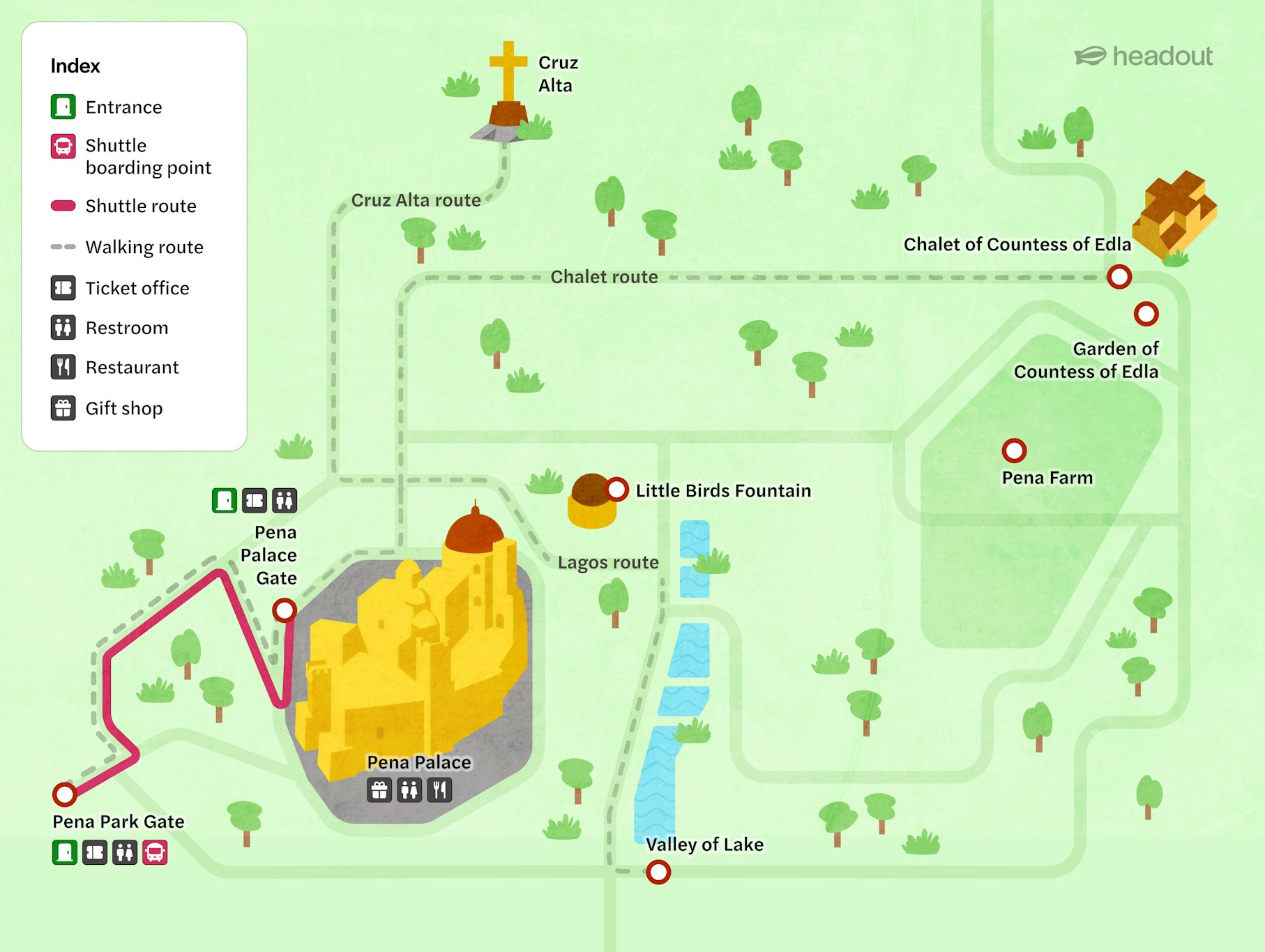
Para entrar en el Palacio da Pena, necesitarás una entrada que incluye el acceso tanto a los interiores como a las terrazas. La entrada al palacio propiamente dicha tiene franjas horarias, por lo que es importante que llegues a la hora designada impresa en tu entrada. Tras pasar por la entrada principal del parque, puedes subir a pie (unos 30 minutos) o coger el autobús lanzadera (disponible por un módico precio) que te deja más cerca de la entrada del palacio. Una vez en el palacio, sigue el camino marcado hasta la cola de entrada. Prepárate para una corta espera durante las horas punta, sobre todo en verano. Los visitantes deben tener en cuenta que a los interiores del palacio y a las terrazas se accede por puntos de entrada separados, pero están incluidos en la misma entrada.
The palace rooms are beautiful, but they're a completely different experience when someone's whispering the story in your ear. A Pena Palace audio guide lets you move at your own pace while getting the context that the room placards simply don't have space for.


The crown jewel of the Pena Palace interiors and the room that stops people mid-step. King Ferdinand II modelled it on Moorish palaces, filling it with horseshoe arches, geometric tile patterns, and stucco work so intricate it looks like lacework carved in stone.
Why it matters: It's a window into Ferdinand's obsession with blending cultures, decades before "fusion" was fashionable.
Pro-tip: Look up at the ceiling. The decorative detail overhead is just as impressive as the walls, and most visitors miss it entirely.
King Carlos I's bedroom remains exactly as it was when he last slept in it, before his assassination in 1908. Rich textiles, carved furniture, and personal objects still in place. Queen Amélia's boudoir next door is more intimate, lined with personal photographs and decorative objects that feel almost uncomfortably private.
Why it matters: These aren't staged rooms. They're real spaces where real people lived, which makes them far more affecting than most palace interiors.
Pro-tip: Slow down here. The personal objects are easy to miss if you're moving with the crowd.
One of the oldest parts of the building, the chapel dates back to the original 16th-century Hieronymite convent that stood here before Ferdinand rebuilt it into a palace. The original Manueline altarpiece in alabaster is the standout piece: carved in the 1500s and somehow still in near-perfect condition.
Why it matters: It's the one space where you feel the full 500-year arc of the site's history in a single room.
Pro-tip: Visit early, it's a compact space that gets crowded fast, and you want time to take it all in.
The dramatic gateway that connects the outer courtyard to the palace interiors. The half-man, half-fish figure of Triton towers over the entrance, carved in elaborate detail representing the divide between the aquatic and terrestrial worlds. For a seafaring nation like Portugal, the symbolism ran deep.
Why it matters: It sets the tone for everything inside Pena Palace, which is theatrical, symbolic, and unlike anything you've seen elsewhere.
Pro-tip: Stop and face back toward Sintra from under the arch. The framed view of the village below is one of the best photo spots on the entire visit.
Most visitors rush past the kitchens to get to the grand rooms, which is exactly why you shouldn't. Rows of copper pots, vintage stoves, and traditional tools tell a surprisingly vivid story of how a 19th-century royal household actually functioned day to day.
Why it matters: It's one of the most humanizing spaces in the palace. Proof that even royalty needed lunch.
Pro-tip: The pantry adjacent to the kitchen has original ceramic storage jars still on the shelves. Easy to overlook, worth a look.
The Queen's Terrace is where the Palacio da Pena interior spills into open air. A large sundial and solar quadrant that was once used to fire a small cannon to announce royal presence still stand at the centre. The watchtowers beyond offer unobstructed panoramas over Sintra's forest canopy and, on a clear day, straight to the Atlantic.
Why it matters: After the intimacy of the indoor rooms, the terrace delivers the scale, a reminder of just how dramatically positioned this palace really is.
Pro-tip: Late afternoon light hits the terrace from the west, making it the best time for photos without harsh shadows.
Used for royal banquets and official gatherings, the Great Hall is the most overtly grand space in the palace. Ornate chandeliers, decorated ceilings, and regal motifs on every surface answer, "Is it worth going inside Pena Palace?" with a resounding yes.
Why it matters: It captures the full ambition of Ferdinand's vision: a palace that would announce Portugal's Romantic ideals to the world.
Pro-tip: Compare it to the intimate royal bedrooms you'll visit nearby. The contrast between public grandeur and private modesty is one of the most interesting things about this palace.
| Ticket type | Access | Entry | Guide | Duration | Best for |
|---|---|---|---|---|---|
General entry | Palace interiors + terraces + park | Timed entry | — | Flexible duration | Repeat visitors, independent explorers |
General entry + audio guide | Palace interiors + terraces + park | Timed entry | Multilingual audio guide | Flexible duration | First-timers who prefer going at their own pace |
Guided tour | Palace interiors + terraces + park | Timed + hosted entry | English or Portuguese-speaking guide | 1.5-hour guided tour + free time to explore the park | First-timers who want context and stories |
Thematic guided tour | Palace interiors + terraces + park | Timed + hosted entry | English or Portuguese-speaking guide | 1.5-hour guided tour + free time to explore the park | History buffs, architecture lovers, those who want the full picture |
If it's your first time inside, the guided tours are genuinely worth it. The rooms are beautiful, but they're significantly more interesting once you know why Ferdinand designed them the way he did, who slept where, and what happened here on October 5, 1910.
En el interior del Palacio da Pena, puedes explorar diversas habitaciones opulentas, como el Gran Comedor, la Terraza de la Reina y el Despacho del Rey Carlos. Estos espacios muestran el esplendor real del siglo XIX y estilos arquitectónicos eclécticos. Además, hay comedores, despensas, capillas y patios, que proporcionan una visión completa de la vida y la historia del palacio.
La Capilla de Nuestra Señora de la Peña es una de las pocas estructuras originales que quedan del antiguo monasterio que hubo en el lugar. A pesar de su modesto tamaño, la capilla ostenta intrincados detalles y sirve de testimonio de la herencia religiosa del palacio.
Sí, puedes recorrer el Despacho del Rey Carlos, que le servía de lugar de trabajo y linda con su dormitorio. Los muros presentan pinturas del propio rey Carlos, que representan escenas del Aparcamiento de Pena. Estas obras ofrecen una visión personal de las inquietudes artísticas del rey.
Las torres de vigilancia del Palacio da Pena, con su diseño de inspiración medieval, se construyeron tanto por estética como por vigilancia estratégica. Históricamente, desempeñaron un papel crucial en la vigilancia del recinto del palacio. Hoy en día, ofrecen a los visitantes impresionantes vistas panorámicas del paisaje circundante, incluidos los frondosos bosques de Sintra y el lejano océano Atlántico.
Para apreciar plenamente el interior del Palacio da Pena, se recomienda dedicar al menos 40 minutos a los camarotes y otros 30 minutos a las terrazas y la capilla. Sin embargo, muchos visitantes prefieren pasar más tiempo explorando las distintas habitaciones y empapándose de su rica historia.
Sí, hay tours guiados disponibles para los visitantes que deseen profundizar en la historia, la arquitectura y las historias que hay detrás del Palacio da Pena. Estos tours a menudo proporcionan acceso a zonas no disponibles durante las visitas autoguiadas
Walk-up tickets are occasionally available at the gate, but slots sell out days or weeks ahead during peak season. Booking online in advance is strongly recommended, it also lets you choose your preferred entry rather than taking whatever remains.
El Palacio da Pena es una fusión de múltiples estilos arquitectónicos, incluidos elementos góticos, moriscos, manuelinos y renacentistas. Esta mezcla deliberada pretendía evocar un pasado onírico y fantástico, típico de la sensibilidad romántica.
El palacio se reconoce al instante por sus llamativas fachadas rojas y amarillas, que realzan su aspecto de cuento de hadas. Estos atrevidos colores se restauraron basándose en pinturas y bocetos originales del siglo XIX y son una parte clave de la identidad visual del palacio.
Por todo el palacio encontrarás símbolos mitológicos y religiosos, como el famoso Arco de Tritón, que representa la alegoría de la creación. Los azulejos, tallas y esculturas son ricos en detalles simbólicos, que contribuyen al significado estratificado del palacio.
El palacio fue diseñado para integrarse armoniosamente en el paisaje natural de las colinas de Sintra. Su emplazamiento en una elevada cima y su integración en el exuberante entorno del Parque de la Peña son típicos de los ideales románticos que celebraban la naturaleza y la emoción.
A focused sweep of the best the Palacio da Pena interior has to offer.
Best paired with a thematic guided tour for an added theatrical flair.