How to visit Lisbon’s Maritime Museum
The Maritime Museum of Lisbon, or Museu de Marinha, is a maritime museum best known for Portugal’s seafaring history, from caravels and navigation tools to royal barges. The visit feels easier than many Belém landmarks because it is calmer, flatter, and usually less crowded than Jerónimos Monastery next door, but the layout still rewards a plan because the separate Barge Hall is easy to miss. This guide covers timing, entrances, route, and the practical details that make the visit smoother.
Quick overview: Maritime Museum of Lisbon at a glance
If you’re deciding whether to fit this into a Belém day, this is one of the easier museums in the district to do well without overplanning.
- When to visit: Daily, 10am–6pm from May 1 to September 30, and 10am–5pm from October 1 to April 30; the first hour after opening is noticeably calmer than 11am–2pm, because Belém tram arrivals and Jerónimos spillover both peak late morning.
- How long to allow: 45–90 minutes for most visitors, stretching closer to 2 hours if you stop for the maps, astrolabes, royal cabins, and the separate Barge Hall.
- What most people miss: The Barge Hall with the Royal Barge of Maria I and the Archangel Raphael carried on Vasco da Gama’s 1497 voyage are the two easiest major misses.
- Is a guide worth it? Usually not for a short museum-only visit because queues are light and the layout is manageable, but it adds real value if you want the museum woven into a wider Belém history route.
Jump to what you need
🕒 Where and when to go
🗓️ How much time do you need?
🗺️ Getting around
⛵ What to see
♿ Facilities and accessibility
Where and when to go
How do you get to the Maritime Museum of Lisbon?
Belém, beside the Jerónimos Monastery complex and about 7km west of downtown Lisbon, is easiest to reach by train or bus rather than the famously packed tram.
Praça do Império, 1400-206 Lisbon, Portugal | Open in Google Maps
- Train: Belém station → 10-min walk → fastest option from Cais do Sodré, and usually less crowded than Tram 15E.
- Tram: Centro Cultural de Belém stop on 15E → 4-min walk → convenient, but often very full in late morning.
- Bus: 727 or 728 → Centro Cultural de Belém / Mosteiro dos Jerónimos → 3–5 min walk with lower-floor access.
- Taxi/rideshare: Praça do Império drop-off → 1–2 min walk → best option if you’re coming from the waterfront with limited mobility.
Which entrance should you use?
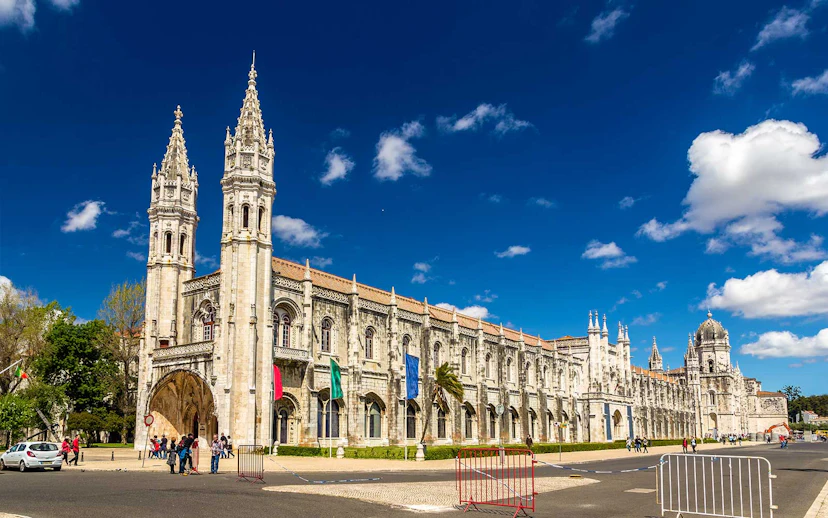
You'll want to head to Praça do Império for the entrance, and it's actually at the opposite end from the Jerónimos Monastery entrance, so don't get confused and line up with the monastery crowd! The museum sits in the west wing of the monastery complex, with a more modern annex north of the monastery for the bigger exhibits like royal barges and seaplanes — so once you're in, just keep walking through.
When is Maritime Museum of Lisbon open?
- May 1–September 30: 10am–6pm
- October 1–April 30: 10am–5pm
- Closed: January 1, Easter Sunday, May 1, and December 25
- Last entry: 30 minutes before closing
When is it busiest? Late morning to early afternoon, especially in summer and on first-Sunday free-entry mornings, when Belém tour traffic is at its heaviest.
When should you actually go? Go at 10am or in the last 90 minutes of the day, when the galleries feel calmer and the Barge Hall is much easier to enjoy without crowding around the vessels.
💡 Pro tip: The first Sunday of the month is free until 2pm, but it’s also the worst time to linger over the model ships and navigation cases. If you care more about the visit than the discount, a paid weekday slot after 3pm is the better trade.
How much time do you need?
The Maritime Museum is compact but deceptively layered, a highlights-only pass through the entrance galleries, model ships, and Barge Hall takes around 45–60 minutes and covers roughly 0.8 km. If you want the fuller story, nautical instruments, royal cabins, the Far East room, build in 75–90 minutes. For a complete visit that includes the maps, astrolabes, and seaplane collection, set aside 2 to 2.5 hours; it's worth it.
How do you get around Maritime Museum of Lisbon?
Layout and suggested route
The museum is split between the quieter monastery-wing galleries and the separate Galliot Pavilion, so it feels larger and more fragmented than the first rooms suggest. In practice, it’s easy to self-navigate, but it’s also easy to leave early and miss the biggest vessels.
- Monastery-wing introduction → Prince Henry, overview displays, and the start of Portugal’s seafaring story → 10–15 min.
- Model ship galleries → caravels, galleons, and the evolution of Portuguese ships → 15–20 min.
- Navigation and treasure rooms → astrolabes, maps, globes, royal cabins, and Far East objects → 15–20 min.
- Galliot Pavilion → Royal Barge of Maria I, fishing craft, and the Santa Cruz seaplane → 20–30 min.
Suggested route: Start in the monastery wing, move steadily through the model and navigation galleries, and deliberately save 20–30 minutes for the Barge Hall at the end, because that’s the section most visitors underestimate.
Maps and navigation tools
- Map: On-site entrance plan → covers the monastery wing and separate Barge Hall → pick it up at the ticket desk before you start.
- Signage: Good enough inside the galleries, but not strong enough to stop people from missing the transition to the Barge Hall.
- Audio guide / app: Not applicable.
- Large outdoor POIs only: Not applicable.
💡 Pro tip: Don’t judge the museum by the first rooms. The full-scale barges are in a separate pavilion, and that’s the point where many short visits become memorable.
Get the Maritime Museum of Lisbon map / audio guide
Where are the masterpieces inside Maritime Museum of Lisbon?

Royal Barge of Maria I
Era: 1780
This is the museum’s knockout object: a long, lavishly decorated ceremonial barge built for Queen Maria I and lined with seats for 80 oarsmen. It’s the piece that most clearly shows how naval power and royal spectacle overlapped in Portugal. What many visitors miss is how much sculptural detail sits above eye level, so step back before you start studying the gilt carvings up close.
Where to find it: In the separate Galliot Pavilion, at the center of the large vessel hall.
Archangel Raphael
Era: 1497
This wooden figure traveled on Vasco da Gama’s voyage to India, which gives it far more historical weight than its modest size suggests. It’s one of the museum’s most direct surviving links to the Portuguese voyages rather than a later reconstruction or model. Many visitors rush past it because the surrounding galleries are dense with ship material, but it’s one of the most important originals in the building.
Where to find it: In the monastery-wing galleries, among the early exploration displays.
Model ship circuit
Attribute — Era: 15th-16th century shipbuilding
The long run of scale models is where the museum quietly becomes excellent, because you can actually see the transition from lighter caravels to larger, square-rigged ships. This is also where the story of exploration becomes technical rather than symbolic. What people often miss is that the differences in rigging and hull shape matter more than the decorative details if you want to understand why Portuguese ships traveled so far.
Where to find it: In the main monastery-wing sequence after the introductory gallery.
Blaeu globe and nautical instruments
Attribute — Era: 17th-century navigation science
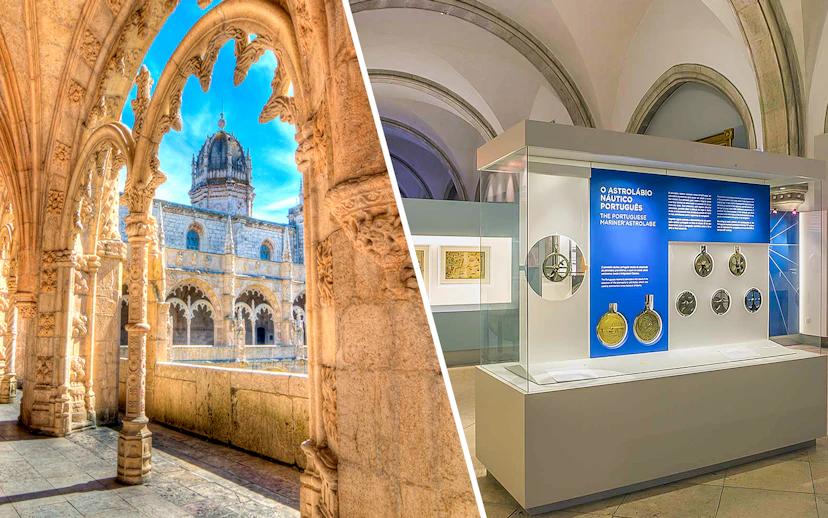
The astrolabes, globes, and instruments are the intellectual heart of the museum, especially if you want more than a parade of ships. The 1645 Blaeu globe makes the collection feel global rather than narrowly Portuguese, and the instruments show how navigation actually worked. Most visitors skim the cases because they are label-heavy, but this is where the museum gets its real depth.
Where to find it: In the navigation and cartography galleries in the monastery wing.
Royal cabins of the yacht Amélia
Attribute — Era: 1900
These reconstructed interiors shift the museum from exploration into status, ceremony, and everyday elite life at sea. The porcelain, crystal, and silver from the royal yacht Sírius make the collection feel more intimate than the larger naval displays. Many visitors don’t spend long here because the barges steal attention, but these rooms explain how maritime prestige lasted well beyond the Age of Discovery.
Where to find it: In the later monastery-wing galleries, before the Barge Hall.
Santa Cruz seaplane
Attribute — Era: 1922 aviation milestone
This aircraft marks the first South Atlantic aerial crossing and helps the museum bridge sea navigation and early long-distance flight. It’s a smart reminder that Portugal’s transport story didn’t stop with wooden ships. What visitors often miss is how naturally it fits the museum’s wider theme of navigation, rather than feeling like a random aviation add-on.
Where to find it: In the Galliot Pavilion, beyond the ceremonial and working boats.
Facilities and accessibility
- 🎒 Cloakroom / lockers: Lockers are available on site, which is especially useful if you arrive in Belém with a day bag, shopping, or luggage before check-in.
- 🍽️ Cafe: There is an on-site café, but it is best treated as a convenience stop for coffee or water rather than somewhere worth planning lunch around.
- 🪑 Seating / rest areas: The widest and easiest place to pause is the Barge Hall, where circulation is roomier than in the model and instrument galleries.
- ♿ Wheelchair loans: Manual wheelchairs are often available at the entrance of the complex, subject to availability, so ask as soon as you arrive rather than after you start the route.
- ♿ Mobility: The museum itself is largely one level with smooth surfaces and is far easier than nearby Jerónimos Monastery or Belém Tower, but getting here from the riverfront can still be the hardest part because the nearest underpass has steep stairs.
- 👁️ Visual impairments: The visit is heavily object- and label-based, with English present in much of the museum, but it is not especially tactile, so visitors who want deeper interpretation usually benefit from coming with a companion or guide.
- 🧠 Cognitive and sensory needs: This is one of Belém’s calmer indoor attractions, and the first hour after opening is the easiest time for a slower-paced, lower-stimulus visit.
- 👨👩👧 Families and strollers: Strollers are allowed and generally easy to use inside, especially in the Barge Hall, though the district’s railway crossings matter more than the museum interior for families.
This museum works best with school-age children who like ships, maps, and large objects rather than hands-on science exhibits, and the Barge Hall is usually the part they remember most.
- 🕐 Time: 45–60 minutes is realistic with younger children, and the smartest priority is the model ships first and the Barge Hall second.
- 🏠 Facilities: Lockers help if you’re carrying extra family gear, and the calmer layout makes it easier to manage a stroller than at many historic Belém sights.
- 💡 Engagement: Turn the early galleries into a spot-the-difference game between caravels, royal ships, and working boats, then save the huge ceremonial barge for the payoff.
- 🎒 Logistics: Bring snacks for before or after rather than during the visit, keep bags light, and avoid late-morning tram arrivals if you’re already managing tired children.
- 📍 After your visit: The Navy Planetarium is the easiest child-friendly add-on nearby if you want to keep the same navigation theme going.
Rules and restrictions
What you need to know before you go
- Entry requirement: A standard museum ticket is enough for the full visit, but bring ID if you’re using a reduced child or senior rate.
- Bag policy: Use the on-site lockers for bulkier bags before you start, because the model galleries are much easier to enjoy without carrying extra weight.
- Re-entry policy: Plan this as one continuous stop, because even if you are only stepping out briefly, Belém’s layout makes quick back-and-forth detours less convenient than they look.
Not allowed
- 🚫 Food and drink belong outside the galleries, so save your pastry stop or lunch for after the visit.
- 🚬 Smoking and vaping are for outdoor areas only, not the monastery wing or the Barge Hall.
- 🐾 Pets are not part of a museum visit here, though service animals should remain with their handler as needed.
- 🖐️ Don’t touch the ships, barges, or navigation objects, because many of the most impressive pieces are fragile originals rather than replicas.
Photography
- Personal photography is usually fine for casual use in the permanent galleries, but follow posted room notices, keep flash off, and leave tripods or selfie sticks behind.
- The most important distinction here is object sensitivity rather than one single no-photo room, so be especially careful in the model-heavy galleries and around reflective cases in the Barge Hall.
Good to know
- Many visitors finish the monastery-wing rooms and leave too soon, missing the separate Barge Hall where the museum’s biggest full-scale pieces are displayed.
- If you’re arriving from the Discoveries Monument side, don’t count on an easy street-level crossing, because the nearest underpass has stairs and is poor for wheelchairs and strollers.
Practical tips
- If you want the first-Sunday free window, be there right at 10am, because by late morning the museum is noticeably busier and the value of free entry starts getting eaten by crowding.
- Do the Maritime Museum between 11am and 1pm if you’re also visiting Jerónimos Monastery the same day, because that is usually when the monastery line is at its worst.
- Take the train from Cais do Sodré to Belém if you’re coming from central Lisbon, because the ride is only about 7 minutes and is usually much less draining than Tram 15E.
- Don’t stop after the early model galleries; hold back 20–30 minutes for the separate Barge Hall, or you’ll miss the museum’s strongest section.
- Use the lockers if you’re coming straight from the airport, station, or a full Belém walking day, because the museum is calmer and more enjoyable with just a small bag.
- Treat the on-site café as a backup, not a plan. If you want the classic Belém pairing, finish the museum first and then walk 5–7 minutes to Pastéis de Belém.
- If you’re approaching from the riverfront, check your crossing point before you start walking, because the railway line makes short distances look easier on a map than they feel in person.
- Give the navigation instruments at least 10 extra minutes if you enjoy context, because that is the section most people skim even though it explains how the voyages actually worked.
What else is worth visiting nearby?
Jerónimos Monastery
- Distance: 120m — 2-min walk
- Why people combine them: They sit in the same monumental complex, and the museum gives you the maritime context that makes the monastery’s symbolism land more clearly.
Navy Planetarium
Distance: 180m — 2–3 min walk
Why people combine them: It extends the same navigation-and-exploration theme in a more family-friendly, immersive format and is easy to slot into the same half-day.
National Coach Museum
- Distance: 850m — 10–12 min walk
- Worth knowing: It pairs well if you liked the royal side of the Maritime Museum, because both collections show how pageantry and transport overlapped in Portuguese court life.
Eat, shop and stay near Maritime Museum of Lisbon
- On-site: The museum café is basic and best used for a quick coffee or bottle of water, not as your main lunch stop.
- Pastéis de Belém (5-min walk, Rua de Belém 84–92): Custard tarts, coffee, and the most logical post-museum stop if you want the classic Belém experience done properly.
- Este Oeste (6-min walk, Praça do Império, Centro Cultural de Belém): Pizza, sushi, and salads in a calmer sit-down setting that works better than the museum café for lunch.
- Pão Pão Queijo Queijo (6-min walk, Rua de Belém 57): Quick sandwiches and lighter plates that make sense if you want speed before continuing around Belém.
- Pro tip: Go to Pastéis de Belém before 12 noon or after 3pm if you don’t want your pastry stop to take as long as the museum itself.
- Museum shop: Maritime books, model ships, postcards, and navy-themed gifts near the exit make this the best stop for something more specific than a generic Lisbon souvenir.
- Pastéis de Belém shop: Boxed pastries and branded tins at Rua de Belém 84–92 work best if you were already stopping there and want an easy edible gift.
Belém works well for a short, museum-focused stay, but it is not the easiest all-purpose base for a first visit to Lisbon. The neighborhood is broad, riverside, and pleasant by day, yet quieter at night and less convenient than Baixa or Chiado if you want to walk to dinner and transit in every direction.
- Price point: The area leans mid-range to upscale, with fewer budget options than central Lisbon and better value once you move a little away from the riverside landmarks.
- Best for: Travelers who want Jerónimos Monastery, the Maritime Museum, and the Belém waterfront within easy walking distance the next morning.
- Consider instead: Baixa and Chiado for a first-time Lisbon base with better transit and food options, or Alfama and Avenida da Liberdade if you want either neighborhood atmosphere or broader hotel choice.
Frequently asked questions about visiting Maritime Museum of Lisbon
Most visits take 45–90 minutes. If you move quickly through the monastery-wing galleries and focus on the Barge Hall, you can do it in under an hour, but 75–90 minutes is a much better pace if you also want the maps, navigation instruments, and royal rooms.
No, you usually don’t need to book far in advance for this museum. Unlike Jerónimos Monastery next door, the queue here is often short, and many visitors are fine buying on arrival, though booking ahead still helps on summer late mornings and first-Sunday free-entry days.
About 10–15 minutes early is enough. This is not a high-friction, heavily timed-entry museum, so the goal is less about beating a strict slot and more about starting before the late-morning Belém crowds reach the galleries.
Yes, but smaller is better. Lockers are available on site, and using them is worth it if you have a bulky day bag, because the model galleries are more enjoyable when you’re not maneuvering around cases and other visitors with a backpack.
Yes, personal photos are generally fine in the permanent galleries. Keep flash off, watch for room-specific signs, and don’t bring tripods or selfie sticks, especially in the tighter object-heavy rooms where space and preservation matter more than at the larger Barge Hall.
Yes, and it works well for groups because the route is calmer and easier than some nearby landmarks. The only real downside is that the model galleries feel tighter at busy times, so large groups are better off arriving near opening than late morning.
Yes, especially for children who like ships, maps, and large objects. Younger children usually respond best to the model ships and the huge ceremonial barges, while older children get more out of the story of exploration, navigation, and royal travel.
Mostly yes inside the museum, and it is one of the easier Belém attractions for wheelchair users. The harder part is often getting there from the riverfront, because some nearby crossing points over or under the railway line involve stairs, so a taxi or bus can be the simpler option.
Yes, but the best food is near the museum rather than inside it. The on-site café is serviceable for a quick drink, while Pastéis de Belém and several other Belém spots are within a 5–10 minute walk and make a better meal or pastry stop.
Yes, entry is free until 2pm on the first Sunday of each month. It’s a good budget option, but it’s also one of the busiest windows to visit, so you should expect a less peaceful experience in the model and navigation galleries.
The train from Cais do Sodré to Belém is usually the smartest choice. The ride takes about 7 minutes, avoids the crush of Tram 15E, and still leaves you with only about a 10-minute walk to the museum through Belém.