Vasco da Gama Aquarium visitor guide
The Vasco da Gama Aquarium is a historic aquarium-museum best known for its live Portuguese marine life displays and King Carlos I’s oceanographic collection. It’s much smaller and quieter than Lisbon Oceanarium, which is exactly why pacing matters here: the visit is easy, but it’s also easy to breeze past the invertebrates corridor or rush upstairs for the giant squid too soon. A good visit comes down to route, timing, and knowing what’s worth slowing down for.
Quick overview: Vasco da Gama Aquarium at a glance
This is an easy, low-stress visit, but a little planning still makes it noticeably better.
- When to visit: Weekdays are usually the calmest. A weekday afternoon outside school holidays is noticeably calmer than a weekend late morning, because this is still a popular family and school-group attraction more than a big-ticket tourist crush.
- Getting in: From €7 for standard entry. There isn’t a separate skip-the-line tier, but online tickets save you the ticket-desk wait. Book ahead for weekends, school breaks, and free-entry days; on most other days, same-day entry is usually fine.
- How long to allow: 1–2 hours for most visitors. Families, slow readers, and anyone who lingers in the museum and interactive hall will land closer to the 2-hour mark.
- What most people miss: The invertebrates gallery and the historical displays around King Carlos I’s research work are easy to rush past on the way to the giant squid.
- Is a guide worth it? Usually, no for a standard visit, because the route is short and the labels do a solid job; a guided visit adds most value if you want deeper context on the royal collection and marine science history.
Jump to what you need
🕒 Where and when to go
🗺️ Getting around
🐠 Which animals and habitats should you prioritise?
♿ Facilities and accessibility
Where and when to go
How do you get to Vasco da Gama Aquarium?
The aquarium sits in Dafundo, just west of Belém, along the Tagus waterfront and within easy reach of central Lisbon by train or taxi.
Rua Direita do Dafundo, 18, Cruz Quebrada – Dafundo, Portugal
- Train: Cruz Quebrada on the Cascais Line → 5–10-minute walk → easiest option from Cais do Sodré.
- Bus: Carris 751 or 776 → Dafundo/Algés area stop → short final walk if you’re coming from Belém or central Lisbon.
- Taxi/rideshare: Drop-off at the entrance → simplest choice with strollers or if you’re short on time.
- Car: Small free parking lot and street parking → useful if you’re combining the aquarium with Belém or the coast.
Which entrance should you use?
There’s one main entrance, but the small decision that matters is whether you buy on-site or arrive with your ticket already on your phone.
- Online tickets/e-tickets: For pre-booked visitors. Expect little to no wait on most days, and the process is smoother on weekends.
- On-site ticket desk: For walk-up visitors. Expect a longer wait on free-entry dates, school breaks, and family-heavy weekend mornings.
When is Vasco da Gama Aquarium open?
- Daily: Check the current day’s schedule before you go, as hours can shift around holidays and special dates.
- Free-entry dates: May 20 and June 1 are much busier than an average day.
- Last entry: Arrive with at least 60–90 minutes left if you want time for both the live tanks and the upstairs museum.
When is it busiest? Summer afternoons, weekend late mornings, and school-holiday periods feel busiest, especially when family visits overlap with day-trippers already exploring Belém.
When should you actually go? A weekday afternoon outside school holidays is the easiest window, because school groups skew earlier and local family traffic skews later and on weekends.
Which Vasco da Gama Aquarium ticket is best for you
| Ticket type | What's included | Best for | Price range |
|---|---|---|---|
Tickets to Vasco da Gama Aquarium in Lisbon | Entry to the aquarium and museum | A short, self-paced visit where you want both the live tanks and the historical collection without paying for extras you won’t use | From €7 |
How do you get around Vasco da Gama Aquarium?
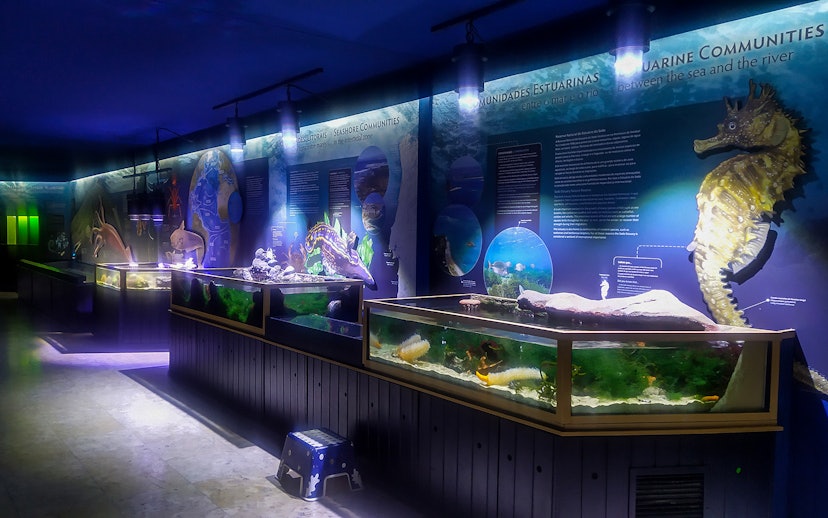
The layout is compact and mostly linear, with live exhibits downstairs, historical museum galleries upstairs, and one modern interactive room that breaks up the older museum rhythm. It’s easy to self-navigate, but easy enough to rush that a simple route helps.
Main layout
- Ground-floor live tanks: Portuguese coastal species, tropical fish, and freshwater displays → allow 30–40 minutes.
- Invertebrates gallery: A corridor of smaller tanks showing marine evolution from simpler life forms to more complex species → allow 10–15 minutes.
- Upper museum galleries: King Carlos I’s preserved specimens, instruments, and maritime material → allow 20–30 minutes.
- ‘Window to the Ocean’ hall: Large interactive digital room with motion-reactive marine visuals → allow 10–15 minutes.
Suggested route: Start downstairs with the live tanks, slow down properly in the invertebrates gallery, then head upstairs for the giant squid and King Carlos I collection, finishing in the interactive hall so the visit ends on a more playful note.
Maps and navigation tools
- Map: Entrance orientation panels and room-by-room labels cover the route well; take a quick photo of the floor plan when you arrive.
- Signage: Wayfinding is good enough for a self-guided visit, but the invertebrates corridor is the section most people unintentionally skim.
- Audio guide/app: You don’t need to build this visit around an Audioguide, because the labels and interactive hall already do most of the explanatory work.
💡 Pro tip: Don’t head upstairs the moment you spot signs for the giant squid; the invertebrates gallery on the way is one of the most distinctive parts of the whole aquarium.
Which animals and habitats should you prioritise?

Giant squid specimen
Species: Deep-sea cephalopod
This is the aquarium’s signature museum piece, and it earns the attention it gets. Suspended in a preserved display, the giant squid feels startlingly large in person, especially once you notice the length of the tentacles and how narrow the museum room around it actually is. What most visitors miss is that it’s part of a broader historical collection, not a standalone oddity.
Where to find it: Upstairs in the King Carlos I oceanographic museum galleries.
Portuguese coastal tanks
Habitat: Atlantic waters around Portugal
These tanks are the clearest expression of what makes this aquarium different from a flashier global aquarium. Instead of going all-in on spectacle, they focus on species you’d actually associate with Portugal’s coast, which makes the visit feel rooted in place. Most people hurry past looking for the tropical fish, but these local habitats are the most venue-specific part of the collection.
Where to find it: On the ground floor in the main live exhibit galleries.
Invertebrates gallery
Habitat: Marine invertebrate ecosystems
This narrow run of smaller aquariums is one of the smartest-curated sections in the building. It walks you through marine invertebrates in a way that feels more like a compact science exhibit than a standard aquarium corridor, with creatures like starfish, crabs, anemones, and octopus getting more attention than they usually do. Visitors often treat it like a passageway when it’s actually a highlight.
Where to find it: Between the main live tank galleries and the route toward the upper museum level.
King Carlos I collection
Era: Late 19th-century oceanographic research
This museum section is where the aquarium shifts from family outing to something more historically unusual. Preserved marine animals, research instruments, and materials tied to King Carlos I’s expeditions give the whole venue real depth and context. What many people miss is how much of the aquarium’s identity comes from this collection, not just the live animals downstairs.
Where to find it: Upstairs, beyond the main staircase and museum entrance.
‘Window to the Ocean’ interactive hall
Exhibit type: Immersive digital installation
This is the clearest sign that the aquarium isn’t just living off its past. The huge digital wall and motion-reactive visuals let children and adults interact with marine scenes in a way that feels playful without becoming gimmicky. Many visitors think of it as a kids-only room, but it’s also one of the best places to understand the aquarium’s modern update.
Where to find it: In the dedicated immersive hall within the museum route.
Facilities and accessibility
- 🍽️ Café: The Nautilus Cafeteria is the on-site food stop for snacks, quick meals, and drinks, and it’s best treated as a convenient break rather than a full destination lunch.
- 🛍️ Gift shop / merchandise: The aquarium shop stocks ocean-themed toys, children’s books, and small souvenirs near the end of the visit.
- 🪑 Seating / rest areas: The compact layout helps, but the café terrace and indoor resting points are the best places to pause if you want to slow the visit down.
- 🅿️ Parking: There’s a small free parking lot plus street parking, which is useful if you’re arriving by car from central Lisbon or combining the aquarium with Belém.
- 👶 Baby-changing: Family facilities include baby-changing support, which makes the aquarium easier with toddlers than many older heritage attractions.
- 🌊 Outdoor break space: The riverside setting and nearby park area give you a natural place to decompress before or after the visit without needing a second attraction ticket.
- ♿ Mobility: The aquarium has ramps and an elevator to the upper museum floor, so wheelchair users can cover the main live exhibits and the historical collection on the standard route.
- 👁️ Visual impairments: Clear exhibit labels and staff support help with orientation, but this is still a visually led experience built around tanks, specimen displays, and projected media.
- 🧠 Cognitive and sensory needs: Weekday visits are calmer, while the ‘Window to the Ocean’ hall is the most visually intense area because of its large moving projections and reactive digital floor.
- 👨👩👧 Families and strollers: The route is manageable with a stroller, and the elevator makes the museum level easier to reach without breaking the visit into separate parts.
This is a strong fit for children because the visit is short, visual, and varied, with enough interactive material to hold attention without turning into a full-day stamina test.
- 🕐 Time: Around 1–1.5 hours is realistic with young children, and the best sections to prioritize are the live tanks, the invertebrates gallery, and the interactive hall.
- 🏠 Facilities: The café, baby-changing support, stroller-friendly route, and on-site shop make the visit straightforward with toddlers and elementary-age kids.
- 💡 Engagement: Let children compare the live tanks downstairs with the preserved specimens upstairs so the visit feels like a story, not just a sequence of rooms.
- 🎒 Logistics: Bring a light bag, keep the pace relaxed, and aim for a quieter weekday if your child gets overstimulated by weekend family crowds.
- 📍 After your visit: The nearby riverside space and playground area make an easy decompression stop before heading on to Belém or back into central Lisbon.
Rules and restrictions
What you need to know before you go
- Entry requirement: Mobile or printed tickets work at the entrance, and booking online is the smoother option if you’re visiting on a weekend or a free-entry date.
- Bag policy: Bring a small day bag rather than bulky luggage, because the galleries are compact and the visit is built for a light, self-paced route.
- Re-entry policy: Admission is single-entry, so plan your snack break, riverside walk, or next stop for after the visit rather than leaving midway.
Not allowed
- 🚫 Food and drink: Keep food and drinks for the café or outdoor areas instead of carrying them through the exhibit rooms.
- 🚬 Smoking and vaping: Treat the building interior as non-smoking and step away from the entrance if you need an outdoor break.
- 🐾 Pets: Don’t plan to bring pets into the aquarium; if you rely on a service animal, check access arrangements before you go.
- 🖐️ Touching exhibits: Don’t tap the glass or handle museum displays, because this is both a live-animal venue and a historic collection.
Photography
- Personal photos fit the visit well, especially in the live aquarium halls and the interactive ‘Window to the Ocean’ space.
- Be more careful upstairs, where reflective museum cases and tighter aisles make flash, tripods, and selfie sticks more disruptive than useful, and follow any room-specific signage if a temporary display uses different rules.
Good to know
- Children: Children under 4 enter free, but they should stay with an adult throughout the visit.
- Free-entry dates: May 20 and June 1 feel very different from a normal visit, so don’t judge the aquarium’s usual pace by those queues.
Practical tips
- Booking and arrival: Book ahead for weekends, school holidays, and free-entry days, but on a normal weekday, this is one of Lisbon’s easier last-minute visits, and you don’t need a huge lead time.
- Pacing: Start with the live tanks downstairs and save the museum for the second half, because people who go hunting for the giant squid too early usually end up backtracking.
- Crowd management: Weekday afternoons tend to work best, because family traffic builds on weekends and school groups are more likely earlier in the day on weekdays.
- What to bring or leave behind: Travel light with just your phone, wallet, and a small bag, since this is a compact route and bulky luggage makes the upstairs museum feel tighter than it needs to.
- Food and drink: Eat after the visit if you want a proper meal, because the Nautilus Cafeteria is useful for a quick break, but the better dining choices are farther east toward Belém.
- Trip planning: This works especially well paired with Belém, since the aquarium gives you a calmer 1–2-hour stop before or after the city’s busier waterfront landmarks.
- Expectations: Don’t come expecting Lisbon Oceanarium-scale spectacle; come for heritage, unusual specimens, and a quieter, more thoughtful visit, and you’ll enjoy it much more.
What else is worth visiting nearby?
Commonly paired: Jerónimos Monastery
Distance: About 4km — around 10–15 minutes by taxi or 20–30 minutes by public transport
Why people combine them: Both fit a Portugal-and-the-sea day out, and Jerónimos gives you the imperial-maritime context that complements the aquarium’s scientific one.
Commonly paired: Belém Tower
Distance: About 4km — around 10–15 minutes by taxi or 20–30 minutes by public transport
Why people combine them: It’s the more scenic pairing if you want a riverside Lisbon day, with the aquarium offering a quieter indoor stop between Belém’s busier landmark visits.
Also nearby
MAAT
Distance: About 5km — around 15 minutes by taxi or 25–35 minutes by public transport
Worth knowing: It’s a strong add-on if you want to keep the day museum-heavy and stay near the river without repeating the same kind of attraction.
Monument to the Discoveries
Distance: About 4.5km — around 10–15 minutes by taxi or 20–30 minutes by public transport
Worth knowing: This works well if you want a quick, symbolic stop that ties directly into Portugal’s maritime identity after the aquarium.
Eat, shop and stay near Vasco da Gama Aquarium
- On-site: Nautilus Cafeteria, inside the aquarium, handles snacks, light meals, and drinks well, but it’s more convenience stop than memorable lunch.
- Belém riverside dining area: 10–15 minutes by taxi, Belém waterfront; better if you want a proper sit-down meal after the aquarium and more than one place to choose from.
- Algés cafés: Short taxi or bus ride, central Algés; useful for coffee or a quick pastry stop before the visit if you’re arriving from west Lisbon or the coast.
- Belém café zone: 10–15 minutes by taxi, around Jerónimos and the waterfront; best if you’re turning the aquarium into part of a longer sightseeing day and want more reliable meal options nearby.
- 💡 Pro tip: If you’re pairing the aquarium with Belém, eat afterward rather than before — the aquarium visit is short, and the better food choices come once you head east.
- Aquarium gift shop: This is the most useful shopping stop right around the venue, with ocean-themed toys, children’s books, and small souvenirs near the exit.
- Belém souvenir shops: If you want a broader Lisbon souvenir stop, wait until Belém instead of expecting a full shopping district around the aquarium itself.
The area around the aquarium is quiet and practical for a short stop, but it isn’t the strongest base for most Lisbon trips. You’ll get calm riverside surroundings and easier access to Belém and the coast, but fewer obvious hotel, food, and nightlife choices than in central Lisbon.
- Price point: The immediate area is more low-key than central tourist districts, but accommodation choice is thinner and less convenient for a first-time Lisbon stay.
- Best for: Travelers who want a quieter riverside base, easy car access, or a stay that leans toward Belém and the western waterfront rather than downtown.
- Consider instead: Belém works better if you want to stay closer to multiple attractions, and central Lisbon is the stronger fit for longer stays, nightlife, and easier all-around transit.
Frequently asked questions about visiting Vasco da Gama Aquarium
Most visits take 1–2 hours. Around 75–90 minutes is enough for the live tanks, the invertebrates gallery, the giant squid, and the museum upstairs, while families with children or anyone reading the displays closely usually stay closer to 2 hours.
You usually don’t need to book far ahead, but it’s still smart to pre-book for weekends, school holidays, and free-entry dates. On a normal weekday, this is one of Lisbon’s easier same-day attractions, and online tickets mostly help by speeding up entry rather than rescuing a sold-out day.
You don’t need a huge buffer here, and arriving 10–15 minutes early is usually enough. This isn’t a large, queue-heavy attraction on most days, but arriving a little early gives you time to scan your ticket, settle kids, and start before family traffic builds.
Yes, a small backpack or day bag is the easiest option. The route is compact and the upstairs museum can feel tighter than the ground floor, so this isn’t the place to arrive with bulky luggage if you want the visit to feel comfortable.
Yes, personal photography fits the visit well in most areas. The live tanks and interactive hall are the easiest places to shoot, while the upstairs museum has tighter aisles and more reflective cases, so it’s better to keep your setup simple and follow any room-specific signs.
Yes, and it works especially well for school groups and small educational groups. The aquarium already has a strong teaching angle, and the mix of live exhibits, museum material, and the interactive hall makes it more group-friendly than its compact size might suggest.
Yes, it’s one of the easier family visits in Lisbon if you want something short, affordable, and educational. The scale works well for younger attention spans, and features like step stools, family facilities, and the interactive digital hall help keep the visit engaging.
Yes, the main route is accessible, with ramps and an elevator to the upper museum floor. That means wheelchair users can cover both the live aquarium exhibits and the historical collection without having to skip the second half of the visit.
Yes, if you want a different kind of experience rather than a bigger version of the same thing. Lisbon Oceanarium wins on scale and spectacle, while Vasco da Gama Aquarium is better for history, unusual preserved specimens, and a quieter, more local-feeling visit.