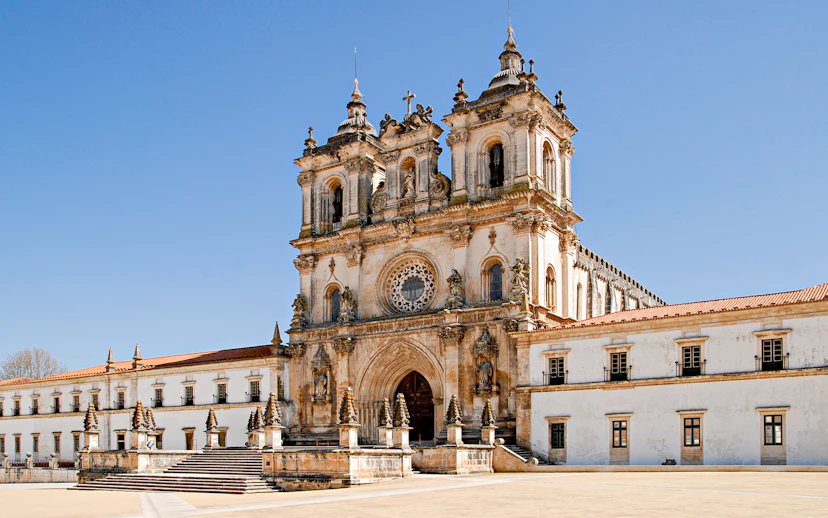
Plan your visit to Alcobaça Monastery
Alcobaça Monastery is a UNESCO-listed Cistercian abbey best known for its vast Gothic church and the tombs of King Pedro I and Inês de Castro. The visit is calm rather than overwhelming, but it rewards visitors who understand the layout: the free church is only part of the experience, and the cloister, kitchen, dormitory, and refectory are what make the site feel complete. This guide helps you time your visit, choose the right ticket, and avoid missing the monastery’s best spaces.
Quick overview: Alcobaça Monastery at a glance
This is a straightforward visit once you know what is free, what is ticketed, and when locals tend to show up.
- When to visit: Alcobaça Monastery is busiest in July and August, and Sunday mornings until 2pm are noticeably busier than a weekday morning because Portuguese residents get free entry during that window.
- Getting in: From €15 for standard entry. Alcobaça Monastery Tickets can also be paired with a Lisbon Card upgrade if you are building the visit into a wider Lisbon itinerary, and booking ahead matters most on summer weekends and holiday periods.
- How long to allow: 1–1.5 hours works for most visitors, and it stretches closer to 2 hours if you slow down for the royal tombs, Kings’ Hall, and the upper dormitory.
- What most people miss: The Monastic Kitchen, the refectory pulpit, and the upper cloister details are what make the monastery feel lived-in rather than just monumental.
- Is a guide worth it? Yes, if you want the Pedro and Inês story, the Cistercian layout, and the royal context to make sense; if you mainly want a quiet architectural visit, a self-guided ticket is enough.
Jump to what you need
Where and when to go
How much time do you need to explore Alcobaça Monastery
| Visit Type | Route | Duration | Walking Distance | What You Get |
|---|---|---|---|---|
Highlights Only | Church and royal tombs | 20–30 minutes | Approximately 0.5 km | Quick glimpse of architectural highlights and key artworks. |
Balanced Visit | Church, cloister, royal tombs, refectory, kitchen | 1–1.5 hours | Approximately 1 km | Comprehensive experience of the main attractions. |
Full Exploration | Complete monastery circuit, including Kings’ Hall and dormitory | 1.5–2 hours | Approximately 1.5 km | In-depth understanding of monastic life and historic context. |
Which Alcobaça Monastery ticket is best for you
| Ticket type | What's included | Best for | Price range |
|---|---|---|---|
Alcobaça Monastery Tickets | Entry ticket | A straightforward self-guided visit where you want full access to the paid monastery circuit after seeing the free church. | From €15 |
How do you get around Alcobaça Monastery?
Alcobaça is best explored on foot, and most visitors can cover the full route in 1–1.5 hours without feeling rushed. The church is the visual anchor at the front, while the lived-in monastic spaces sit beyond it in a loop that makes more sense once you enter the cloister circuit.
What are the most significant spaces in Alcobaça Monastery?

Church of Santa Maria
Era: 12th–13th-century Gothic
This is the space that gives Alcobaça its first real impact: a huge, stripped-back Gothic church whose height and symmetry do the work instead of decoration. Most visitors notice the scale immediately, but rush too quickly toward the tombs without stopping to look back down the full length of the nave. That long sightline is one of the monastery’s strongest architectural moments.
Where to find it: Directly at the main entrance, before the ticketed monastery circuit.
The tombs of Pedro I and Inês de Castro
Era: 14th-century Gothic sculpture
These are the emotional center of the monastery, not just its best-known artworks. The tombs face each other so the lovers meet again at resurrection, and the carvings reward slow looking, especially on Pedro’s sarcophagus. Most visitors photograph them quickly and leave; stay long enough to notice the narrative scenes and the different creatures supporting each tomb.
Where to find it: In the church transept, facing one another across the crossing.
Cloister of Silence
Era: 13th century, later expanded
This cloister changes the tone of the visit from monumental to meditative. It is large enough to feel open, but still intimate in the way the arches frame light and shadow. Most visitors stay on the lower walkways and miss how good the upper perspective is for understanding the monastery’s scale and rhythm.
Where to find it: Through the paid monastery circuit, directly off the main internal route.
Monastic Kitchen
Function: Working service space
The kitchen is where Alcobaça starts to feel like a real inhabited complex rather than a ceremonial monument. The giant chimney, iron columns, and river-fed water system show how advanced the monastery once was. Many visitors glance up at the chimney and move on, but the basin and water engineering are the detail that makes the room memorable.
Where to find it: Off the cloister route, near the refectory.
Kings’ Hall
Era: 18th-century decorative program in a medieval complex
Kings’ Hall adds a different layer to the visit, with statues of Portuguese monarchs and blue-and-white azulejo panels that frame the monastery’s royal history. It is less dramatic than the church, which is why many people skim it, but it helps you understand how later Portugal remembered the abbey. The tile storytelling is the part most often rushed past.
Where to find it: Near the entrance sequence of the paid circuit.
Dormitory and night stair
Function: Monastic living quarters
The dormitory is one of the best places to understand how disciplined Cistercian life was here. Its plainness is the point: open sleeping space, direct church access, and almost no visual distraction. Because it lacks the instant visual payoff of the tombs or kitchen, many visitors move through too fast, but it is the room that best explains the order’s values.
Where to find it: Upper level of the monastery circuit, reached after the cloister rooms.
Facilities and accessibility
- 🎒 Bags: A small day bag is easiest here, especially if you plan to take the full route through the church, cloister, and upper dormitory.
- 🚻 Restrooms: Restrooms are available on-site, and it is worth using them before you begin the full circuit.
- 🍽️ Food nearby: There is no reason to plan a meal inside the monument because cafés and restaurants sit right outside on the square.
- 🛍️ Gift shop / merchandise: A small bookstore and gift shop near the exit is the best place for books, postcards, and heritage souvenirs.
- 🪑 Seating / rest areas: The church and cloister are the easiest places to pause without breaking your route.
- 📶 Wi-Fi: Free Wi-Fi is available in the entrance hall.
- 🅿️ Parking: A large free parking area on Rua do Mosteiro makes driving here easier than at many historic monuments.
- ♿ Mobility: The church and cloister ground floor are the easiest parts to access, but the upper dormitory level requires stairs, so the full visit is only partially accessible.
- 👁️ Visual impairments: The architecture is legible and uncluttered, but interpretation is limited, so a companion or guide adds real value if you want the story behind the spaces.
- 🧠 Cognitive and sensory needs: This is one of the calmer heritage sites in Portugal, and weekday mornings are usually the easiest low-stimulation window.
- 👨👩👧 Families and strollers: The ground-floor route is simpler than the upper levels, and strollers are easiest in the church and cloister rather than on stairs or tighter internal passages.
Alcobaça works well for school-age children because the spaces feel dramatic, the love story is easy to retell, and the route is short enough not to drag.
- 🕐 Time: Around 45–75 minutes is realistic with younger children if you focus on the church, tombs, cloister, and kitchen.
- 🏠 Facilities: Open cloister space and nearby restrooms make this easier than many tighter historic sites.
- 💡 Engagement: Give children one mission before entering, such as spotting the animals and creatures carved into the tombs or cloister details.
- 🎒 Logistics: Bring a small snack for after the visit rather than during it, and aim for a weekday morning if you want more room to move.
- 📍 After your visit: Pastelaria Alcôa across the square is the obvious child-friendly follow-up for convent sweets after the monastery.
Rules and restrictions
Practical tips for your visit to Alcobaça Monastery
- Booking and arrival: Book ahead for summer weekends or public holidays if you want to walk past the ticket counter, but on most weekdays this is still a genuinely manageable on-the-day visit.
- Pacing: Save your slowest 15–20 minutes for the royal tombs and the cloister, because those are the two places where quick photos are least satisfying.
- Crowd management: Avoid Sunday mornings until 2pm if you can, because the local free-entry window makes the site feel busier than a weekday at the same hour.
- What to bring or leave behind: Bring a light layer in winter because the stone interiors can feel cold, and keep your bag small if you want the dormitory stair and internal route to feel easy.
- Route planning: Don’t stop after the free church unless you only want a 20-minute look; the kitchen, refectory, and dormitory are what make the ticketed visit worth paying for.
- Food and drink: Plan coffee or sweets after the visit at Pastelaria Alcôa across the square, because convent pastries make more sense as a follow-up than a rushed pre-visit stop.
- Same-day pairings: Alcobaça combines cleanly with Nazaré or Batalha, but trying to add both plus long lunch stops can turn a calm visit into a car-heavy day.
What else is worth visiting nearby?
Eat, shop and stay near Alcobaça Monastery
- On-site: There is no meaningful in-monument meal stop to plan around, so treat the square outside as your food zone instead.
- Pastelaria Alcôa (across the square, Praça 25 de Abril): Convent sweets and pastries, moderate prices, and the most context-rich stop after the monastery because the recipes tie directly to monastic traditions.
- Restaurants on Praça 25 de Abril (2–5 min walk, central Alcobaça): Local Portuguese mains at moderate prices, and the easiest sit-down option if you want lunch without moving the car.
- Cafés around Rua Frei Bernardo (5–8 min walk, town center): Coffee and lighter bites, best if you want a quick reset before driving on to Nazaré or Batalha.
💡 Pro tip: Do the monastery first and eat after, because Alcobaça is short enough that a pre-visit lunch often breaks the day’s rhythm more than it helps.
- Monastery bookstore: Books, postcards, and heritage souvenirs near the exit, and the most practical place to pick up something directly tied to the visit.
- Pastelaria Alcôa: Boxed convent sweets worth taking home, directly opposite the monastery and far more memorable than generic souvenirs.
Alcobaça is an easy, low-stress base for one night if your plan is the Silver Coast and central Portugal rather than Lisbon city sightseeing. The town is quieter and less polished than Nazaré or Óbidos, but that also means simpler logistics and a more local pace. For a short heritage-focused loop with Batalha, Nazaré, or Tomar, it works well.
- Price point: Generally more moderate than Portugal’s big city centers, with simpler accommodation stock rather than luxury-heavy stays.
- Best for: Travelers who want a calm overnight stop near the monastery and easy driving access to nearby heritage sites.
- Consider instead: Nazaré if you want sea views and more evening energy, or Óbidos if you want a more atmospheric walled-town stay with stronger leisure appeal.
Frequently asked questions about visiting Alcobaça Monastery
Most visits take 1–1.5 hours. If you only step into the free church and see the royal tombs, you can be done in 20–30 minutes, but the full paid circuit through the cloister, kitchen, refectory, and dormitory is what turns the visit into a proper experience.
No, you usually do not need to book far in advance. Alcobaça is much calmer than Portugal’s highest-demand monuments, but booking ahead still makes sense for summer weekends, public holidays, and same-day plans where you want to skip the ticket counter and keep moving.
It is only occasionally worth it here. Queues are usually short, but they can reach around 10–15 minutes late morning on summer weekends, so mobile entry is mainly about convenience rather than saving a dramatic amount of time.
Arrive about 10–15 minutes early if you have booked ahead. That gives you enough time to orient yourself, step into the church without rushing, and start the paid circuit with the calm part of the visit still ahead of you.
Yes, but a small bag is the smart choice. The route is easier with light gear because you will move through historic interiors and, if you do the full circuit, up to the dormitory level, where bulkier bags become more annoying than useful.
Yes, photography is one of the better parts of the visit. The church, cloister, and kitchen are especially good for photos because of the light and long sightlines, but you should keep an eye on any area-specific signage around temporary displays or protected sections.
Yes, and it works well for groups because the route is compact and easy to follow. Guided groups benefit most from the Pedro and Inês story and the monastery’s historical context, which are the details that turn a visually calm site into a memorable one.
Yes, especially for children who are old enough to engage with stories and big spaces. The visit is short, the cloister gives children room to move, and the royal love story plus the oversized kitchen usually hold attention better than a more text-heavy museum would.
It is partially accessible rather than fully accessible. The church and cloister ground floor are the easiest areas to navigate, but the upper dormitory level requires stairs, so visitors with limited mobility can still see the core highlights but not every part of the route.
Yes, and the best options are right outside rather than inside. Pastelaria Alcôa across the square is the obvious stop for convent sweets, and the restaurants around Praça 25 de Abril make it easy to turn the monastery into a relaxed lunch stop.
Yes, the church is free to enter. You only need a paid ticket for the cloister, dormitory, refectory, kitchen, Kings’ Hall, and the rest of the enclosed monastery circuit.
Yes, and most travelers combine it with one of them rather than both. Nazaré is only about 12km away, while Batalha is about 20km away, so either pairing works comfortably if you keep the day focused and do not overbuild the schedule.